 Blockchain
Blockchain wallet recovery depends on your backup format and custody type
Blockchain wallet recovery can restore your original DeFi Wallet with its 12-word recovery phrase. A custodial account password reset creates a new linked wallet; trading access may still require identity re-verification. Imported addresses need separate recovery material because the phrase doesn’t back them up. Older password mnemonics and encrypted wallet files require recovery tools suited to their formats.
Last updated ·
Start with the balance you need and the credentials you still hold. Keeping your original files and device data intact preserves options while you distinguish a missing password from missing keys or incomplete account authorization.
Bottom line: Restoring generated addresses doesn’t recover imported addresses, so retain their separate private-key backups.
Choose a recovery route from the credentials you still hold
An intact 12-word phrase supports the standard recovery flow for the DeFi Wallet it belongs to. If the original password still works, normal login remains an option, subject to account authorization. A saved encrypted file needs its matching password. If an encrypted mobile cloud backup already exists, you can restore the wallet with your app PIN even after losing the password or phrase. This feature is available from app version 2.57.0 on iOS and 6.36.3 on Android, with wallet cloud backup and device backups enabled. Restoration needs access to the iCloud or Google Drive account holding the backup and a device using the same operating system. Android also requires enabled Google Play services. Having only inbox access points toward custodial account recovery; it doesn’t supply the private keys for the original self-custody wallet.
Decide which balance is missing before changing account credentials. Custodial funds sit under account controls, while DeFi Wallet access relies on your wallet credentials or backup. Blockchain can’t reset the original self-custody password or issue a replacement phrase. Retain old devices, files and separately saved keys while you determine which recovery route applies.
The password, phrase and Wallet ID have different recovery roles
Encrypted wallet access
The original password
Your original password unlocks the encrypted wallet data. Knowing it can keep an existing wallet accessible without a phrase restore. A new password chosen during account recovery won’t decrypt an older backup encrypted with the previous password.
The Wallet ID
The Wallet ID identifies a wallet for login. It isn’t a public receiving address or a private key. Multiple Wallet IDs can share an email address, so matching the correct identifier matters when an old balance appears missing.
Phrase-based key recovery
Your recovery phrase regenerates the private keys for addresses derived from that wallet’s seed. A seed is the starting secret a hierarchical deterministic wallet uses to generate its keys. The same wallet can therefore contain many generated addresses.
A public address shows where funds were sent and lets you inspect public transaction records. It doesn’t grant spending control. Access requires the corresponding private keys, even when an explorer displays the expected funds.
Imported addresses need separate key backups
Recovering a separately imported address requires the private key controlling that address. Blockchain’s recovery phrase doesn’t back up imported addresses. Importing a key adds access to an existing address; it doesn’t derive that key from the wallet’s seed. A successful restore of generated addresses can therefore coexist with an imported balance you still can’t spend. Preserve any separate key backup or an accessible original wallet containing that key.
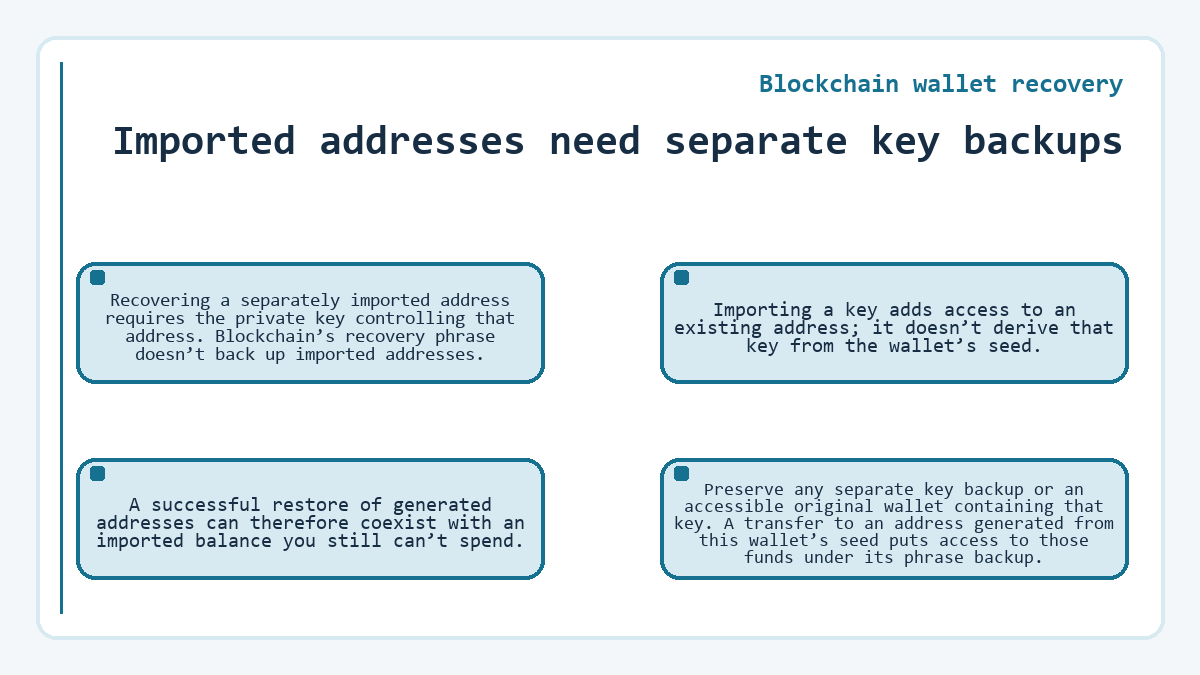
A transfer to an address generated from this wallet’s seed puts access to those funds under its phrase backup.
Legacy phrases and encrypted files need matching recovery tools
Some wallets created before 2016 used password-recovery mnemonics instead of the standard 12-word restoration phrase. Those older mnemonics have a separate purpose and recovery entry point. Don’t shorten or pad an old record to satisfy the modern phrase form.
An older password mnemonic
The applicable legacy recovery tool reveals the password recorded when the mnemonic was created. If you later changed that password, the recovered value may no longer unlock the wallet. Word count alone doesn’t establish the backup format; the recovery tool must match the record you actually have.
An encrypted wallet file
Recovering from a wallet.aes.json backup requires the correct password to decrypt that file.
Importing the file doesn’t bypass encryption. If the legacy wallet used a second password to encrypt its keys, that password is also required to use them. Work from a copy and preserve the original. A matching filename doesn’t prove the file is intact or belongs to the wallet holding the missing balance.
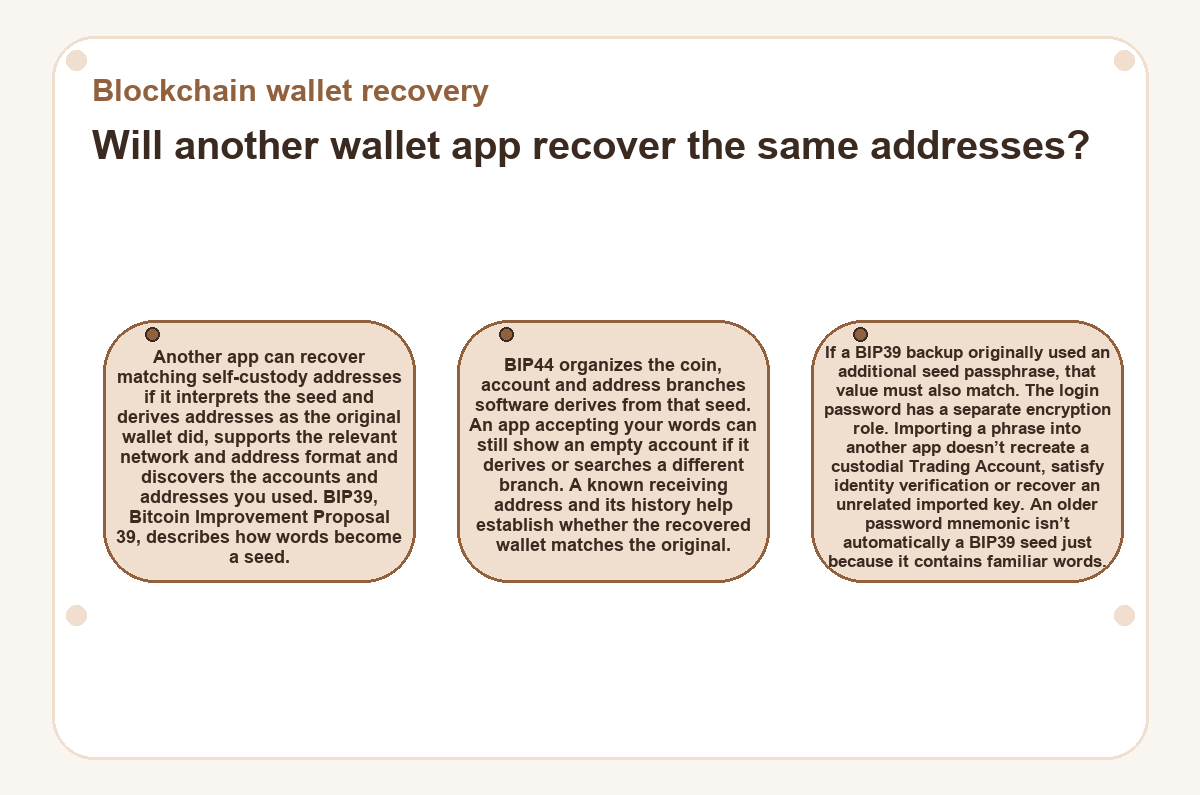
Will another wallet app recover the same addresses?
Another app can recover matching self-custody addresses if it interprets the seed and derives addresses as the original wallet did, supports the relevant network and address format and discovers the accounts and addresses you used. BIP39, Bitcoin Improvement Proposal 39, describes how words become a seed. BIP44 organizes the coin, account and address branches software derives from that seed. An app accepting your words can still show an empty account if it derives or searches a different branch. A known receiving address and its history help establish whether the recovered wallet matches the original.
If a BIP39 backup originally used an additional seed passphrase, that value must also match. The login password has a separate encryption role. Importing a phrase into another app doesn’t recreate a custodial Trading Account, satisfy identity verification or recover an unrelated imported key. An older password mnemonic isn’t automatically a BIP39 seed just because it contains familiar words.
Custodial password resets change the linked DeFi Wallet
A custodial password reset can recover trading access if you’ve lost the account password and don’t have the original recovery phrase. That reset links a new DeFi Wallet to your custodial account. The new wallet has its own Wallet ID and recovery phrase. Its empty balance doesn’t establish what remains at your original self-custody addresses.
Your original wallet remains accessible with its own phrase or the original Wallet ID and usable password. The reset doesn’t make the old backup cover the new wallet. Accounts originally created through Google or Apple sign-up have a separate custodial sign-in option. That login still doesn’t replace the password and any previously enabled two-factor authentication needed to open the original self-custody wallet.
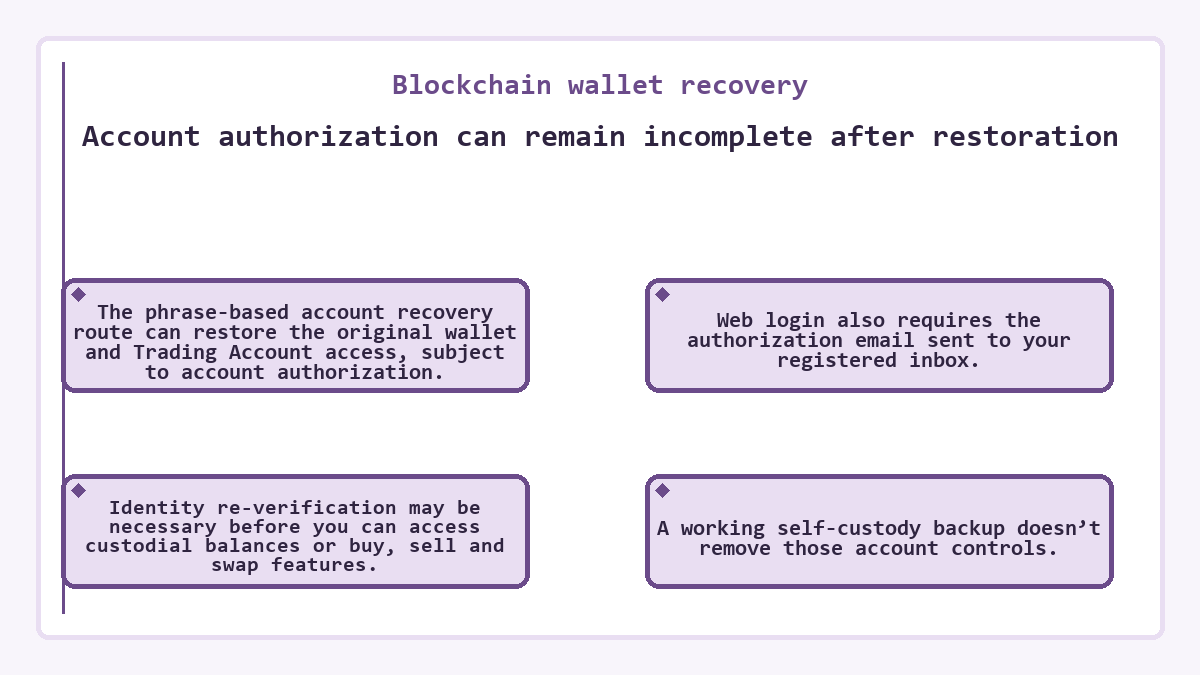
Account authorization can remain incomplete after restoration
The phrase-based account recovery route can restore the original wallet and Trading Account access, subject to account authorization. Web login also requires the authorization email sent to your registered inbox. Identity re-verification may be necessary before you can access custodial balances or buy, sell and swap features. A working self-custody backup doesn’t remove those account controls.
Confirm generated-address recovery before retiring the old device
In this hypothetical example, you have the original wallet’s complete recovery phrase, access to its registered inbox and a record of a prior transaction to an address you believe the wallet generated from its seed. Keep the old device and backup unchanged while checking the recovery route. These assumptions make phrase recovery appropriate; a custodial password reset would attach a different wallet.
Check that Blockchain’s phrase-recovery interface is genuine before entering the words in their recorded order. The web route accepts the phrase before asking you to create a new password. Confirming that password sets the recovered wallet’s login credential. If an authorization message hasn’t arrived, wait for account authorization instead of repeatedly starting password resets.
With the phrase accepted and login completed, the restored wallet’s history matches the saved generated address. Record that match without storing the phrase alongside it. Original self-custody access is restored in this example, and restoring it doesn’t itself move the funds.
If the saved address was imported separately, the phrase still restores the generated wallet, while that address remains absent. Stop before erasing the old device or discarding its files, because they may contain the separate private key.
Keep recovered keys out of recovery scams
Anyone with your recovery phrase and any required seed passphrase can regenerate the wallet’s private keys. Enter it only in a recovery interface you’ve verified belongs to your intended wallet provider, never in a support message or remote-access session. Blockchain staff won’t initiate contact asking for your backup phrase. If you’ve disclosed the complete recovery secret, changing the app password doesn’t revoke that key access. Protecting remaining funds requires moving them to a separate wallet with a new secret, because the exposed keys still authorize spending.
Blockchain wallet recovery - your questions answered
What should I check when the recovery phrase is rejected?
Check the recorded words, their order and the backup format before trying again. The standard restore form expects the original 12-word phrase. BIP39 phrases also contain a checksum, so valid individual words can still form an invalid sequence. Compare the entry with your preserved backup without uploading that backup to a troubleshooting chat.
Where can I find my recovery phrase while I can still sign in?
You can reveal the phrase through the wallet’s Security settings while you still have the required access credentials. The web backup flow displays the words and asks you to confirm them. The mobile app also offers manual backup or Backup to Cloud through Apple iCloud or Google Drive.
Will an old receiving address still work after recovery?
Previously generated receiving addresses remain associated with the same non-custodial Bitcoin wallet. A newer default receiving address doesn’t deactivate earlier ones. Successful recovery of the original wallet’s keys preserves access to those generated addresses, including funds sent to them later.
Is account recovery possible after losing access to my registered email?
Blockchain provides a support process for changing a registered email address when you can’t access the account. You’ll need to supply supporting documents to verify the change. If you can sign in with your password, the email can be changed through account settings. An email change doesn’t supply missing self-custody keys or replace a lost wallet backup.
How long does a two-factor reset request remain valid?
A pending request in Blockchain’s email-based two-factor authentication reset flow expires after three days. The request uses your Wallet ID and registered email address. The confirmation email lets you approve or decline it. Approval also resets enabled IP restrictions, while verified-email security remains intact. Declining cancels the request.
What private-key format does Bitcoin address import accept?
The web wallet’s Bitcoin address import accepts private keys in compressed WIF (Wallet Import Format). This particular address-import feature isn’t available in the mobile app. A receiving address alone doesn’t meet its key requirement. Preserve the original private-key backup and keep it out of online converters or support messages.
Can recovering the wallet cancel a confirmed transfer?
Restoring wallet access can’t cancel a confirmed on-chain transfer. Recovery restores control of the keys and access to funds they still control; it doesn’t reverse the network’s transaction record. Blockchain can’t recover a completed payment by resetting your password or restoring your phrase. A missing balance therefore requires distinguishing lost access from funds already transferred away.