 Blockchain
 combines a self-custody wallet with managed crypto trading
Blockchain offers a self-custody wallet, managed crypto trading and an explorer for public network activity. The DeFi Wallet puts private keys, the credentials used to authorize transfers, under your control. The Trading Account handles custody and supports buying, selling and swapping for eligible accounts. The Exchange’s migration notice scheduled trading suspension for October 19, 2025. These products serve different jobs, with separate access rules and supported assets.
Last updated ·
Restoring a Trading Account password doesn’t restore the original DeFi Wallet or its private keys.
Consumer wallets and business services share the platform
Personal wallet tools, brokerage services and public network data sit alongside integrations and institutional products within the same platform. Pay lets other applications embed crypto buying and selling. Institutional services include over-the-counter trading, custody and staking, with separate product arrangements. The DeFi Wallet also connects to decentralized applications and manages non-fungible tokens (NFTs). Within the consumer app, self-custody and managed trading remain distinct choices even when a single interface presents them together.
Self-custody and managed custody assign control differently
Custody determines who controls the keys behind a balance and what account support can restore after a loss of access.
DeFi Wallet control
Private keys and signatures
The DeFi Wallet generates and stores private keys for addresses it generates. Its software signs a transfer with the relevant private key without disclosing that key to the network. A signature proves authority to spend; network processing determines whether the submitted transaction is accepted. A receiving address lets someone send crypto to you. Possession of a private key lets someone authorize spending from its associated address, which makes keeping that credential secret part of maintaining control.
Wallet access and backups
A wallet password protects access to the encrypted wallet, while its recovery phrase backs up the keys generated from that phrase. Anyone who obtains the phrase can control the keys it backs up. Separately imported addresses aren’t restored through that backup. A Trading Account password reset doesn’t restore an existing DeFi Wallet. Losing access to the wallet’s credentials can leave its funds inaccessible even when the associated custodial account remains available.
Trading Account custody
In the Trading Account, Blockchain manages the private keys behind custodial balances. Account credentials let you request supported trades and transfers through the service. Identity verification and account security checks govern access to these features. This arrangement provides account recovery assistance, alongside dependence on the platform’s custody and withdrawal processes. Fiat balances and account-based bank services sit on the Trading Account side, with regional and payment-method restrictions.
The Trading Account doesn’t expose its private keys for export, so a receiving address doesn’t confer direct control of its custodial balance.
Brokerage quotes differ from the Exchange’s historical order-book model
Buying through the Trading Account presents a quote. The Exchange used an order book. Its migration feature lets eligible linked accounts move Exchange crypto and fiat balances into the Trading Account. Buy supports a cash balance or payment method available to an eligible account. Swap converts eligible crypto balances between supported assets. Advanced Trading offers Options funded with Trading Account USDC for eligible, verified users with regional access who accept the applicable terms and risk acknowledgements. Their USDC balance must cover the premium and applicable fees. After purchase confirmation, buyers can’t change an Option’s terms or close it early. These account services have their own payment and pricing conditions. A trade settled within a custodial account also differs from a transaction signed through the DeFi Wallet, even when both change which asset a person holds.
Price limits and available liquidity
A market order seeks execution against available orders, beginning with the best prices. Its execution price can vary across fills as liquidity changes. A limit order sets a maximum buying price or minimum selling price. It can remain open without filling when matching liquidity isn’t available. Price control therefore comes with a possible wait or an unfilled order. The Exchange supported separate order states, so acceptance of an order didn’t establish execution of its full quantity.
The Exchange’s published API specifications include stop and stop-limit orders. A stop triggers a market order when its trigger price is reached. A stop-limit triggers a limit order at that point, retaining a price condition which can prevent a fill. These are Exchange order controls, separate from Trading Account brokerage quotes.
DEX access and perpetual futures
The DeFi Wallet provides access to decentralized token trading through its DEX integration, where DEX means decentralized exchange. This connects self-custody assets with third-party trading protocols. Their execution rules and network requirements remain separate from custodial brokerage quotes. Wallet support for an asset and an executable trading route are different capabilities; the selected protocol and available liquidity govern the trade. Perpetual futures provide leveraged price exposure without ownership of the underlying asset. Eligible users can access Perps powered by Hyperliquid through the mobile DeFi Wallet interface. Margin requirements and liquidation follow that third-party service’s rules. Insufficient margin can close a position automatically.
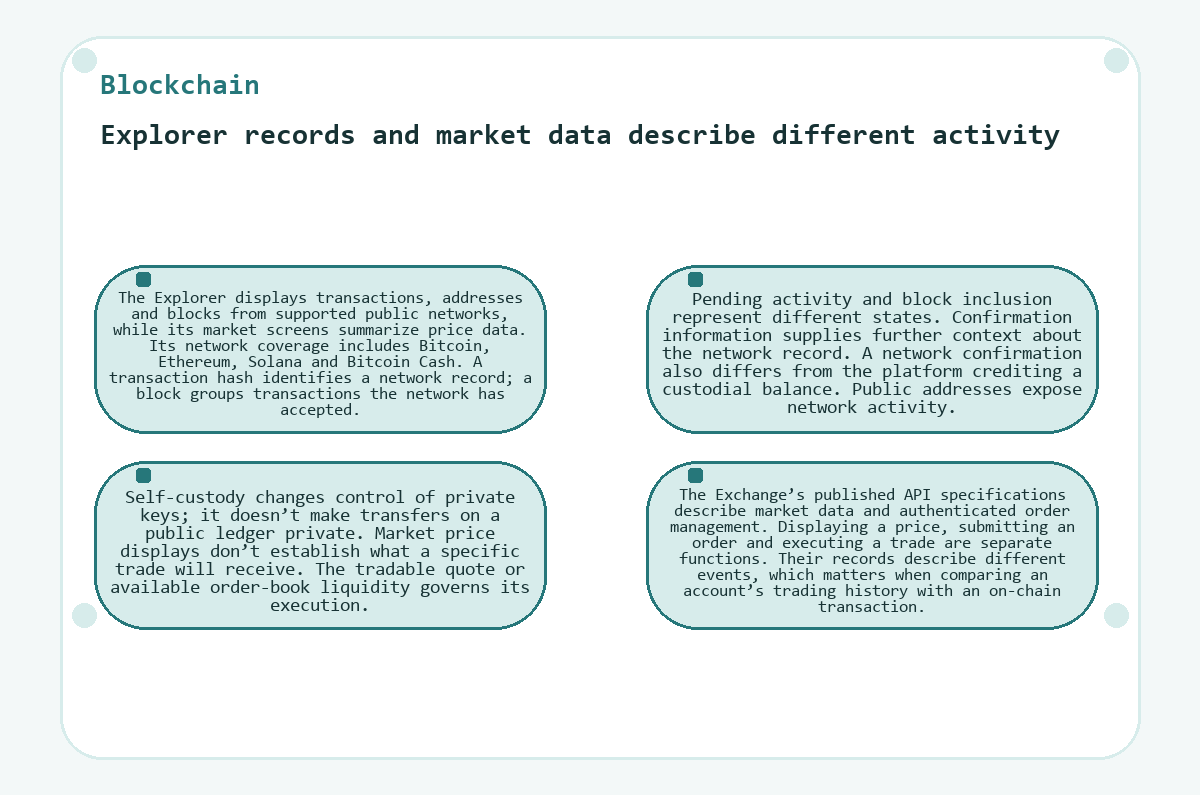
Explorer records and market data describe different activity
The Explorer displays transactions, addresses and blocks from supported public networks, while its market screens summarize price data. Its network coverage includes Bitcoin, Ethereum, Solana and Bitcoin Cash. A transaction hash identifies a network record; a block groups transactions the network has accepted. Pending activity and block inclusion represent different states. Confirmation information supplies further context about the network record. A network confirmation also differs from the platform crediting a custodial balance.
Public addresses expose network activity. Self-custody changes control of private keys; it doesn’t make transfers on a public ledger private.
Market price displays don’t establish what a specific trade will receive. The tradable quote or available order-book liquidity governs its execution. The Exchange’s published API specifications describe market data and authenticated order management. Displaying a price, submitting an order and executing a trade are separate functions. Their records describe different events, which matters when comparing an account’s trading history with an on-chain transaction.
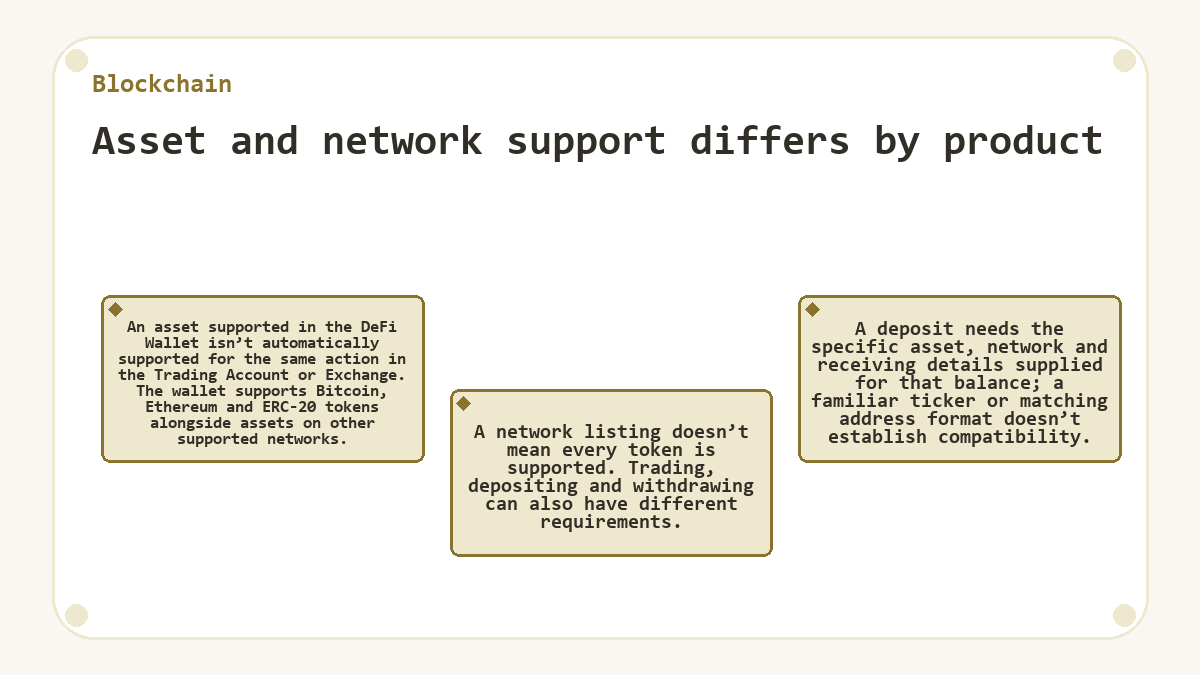
Asset and network support differs by product
An asset supported in the DeFi Wallet isn’t automatically supported for the same action in the Trading Account or Exchange. The wallet supports Bitcoin, Ethereum and ERC-20 tokens alongside assets on other supported networks. A network listing doesn’t mean every token is supported. Trading, depositing and withdrawing can also have different requirements. A deposit needs the specific asset, network and receiving details supplied for that balance; a familiar ticker or matching address format doesn’t establish compatibility.
Network charges and trading costs have different causes
A network fee covers an on-chain transaction; brokerage fees and quoted spreads have separate pricing bases. In the Trading Account’s brokerage service, order size and payment method influence the buy fee. Its quoted price incorporates a spread relative to the open-market rate, which can change with market conditions. Swaps settled entirely inside the Trading Account don’t add a blockchain network fee. That treatment applies to custodial swaps and doesn’t establish the fee treatment of other wallet functions.
An Ethereum token transfer from the DeFi Wallet requires ETH for network gas. The token balance and fee balance can therefore impose different constraints on the same operation. Network demand and transaction requirements influence the fee. Swap fees consequently depend on the selected trading service and settlement method. The Exchange used maker and taker pricing: orders which add liquidity and orders which remove it could incur different trading fees. Its fee schedule set the rates for Exchange trades.
Rewards and loans change how funds are held
Rewards enroll eligible crypto in a separate product, while crypto-backed loans use pledged assets to secure borrowing. Flexible Rewards offers a variable reward rate and withdrawals under its product terms. An October 2, 2026 support notice reported delayed interest payments for some users, with deposits and withdrawals unaffected. It said missed interest would be credited automatically and gave no confirmed payment date. The platform lends enrolled assets to borrowers and receives ownership rights while those assets participate in the program. This arrangement adds borrower and platform risk. It creates a different relationship with the assets from holding their private keys in the DeFi Wallet.
Fixed Rewards adds a defined term and a boosted reward rate for eligible funds. Rewards are paid at term end. Ending a position early through support forfeits the rewards accrued for that term. Available terms depend on the asset. Flexible access and a fixed-term reward commitment therefore carry different conditions, even when funds originate from the same Trading Account.
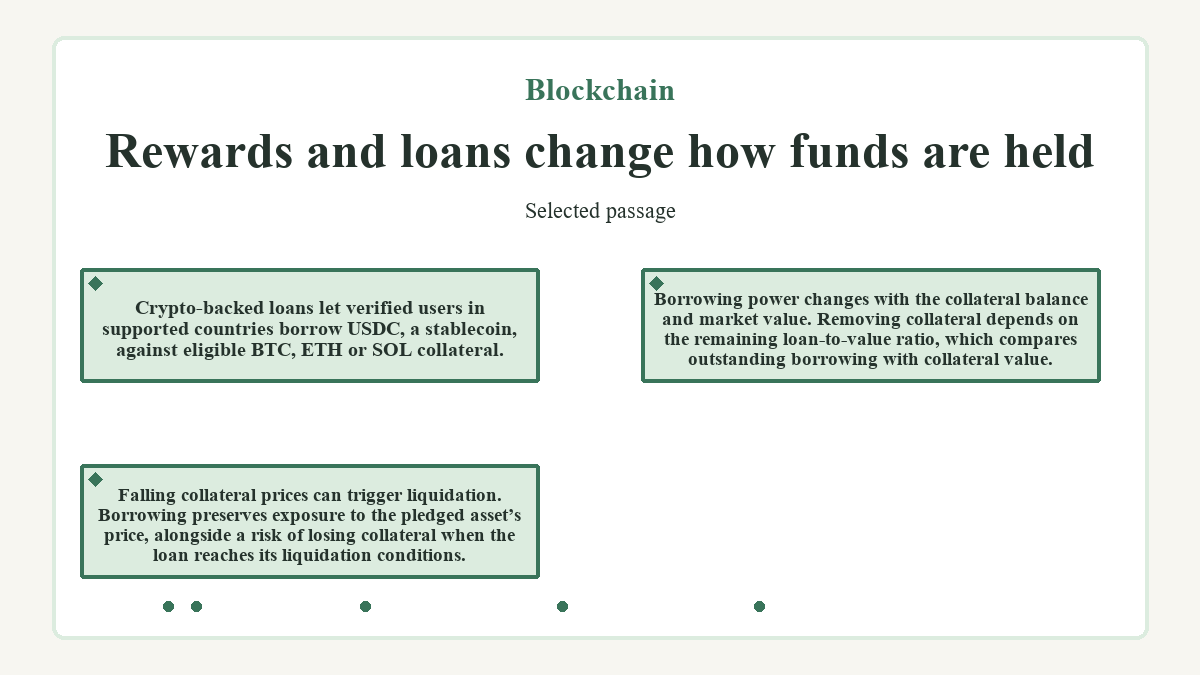
Crypto-backed loans let verified users in supported countries borrow USDC, a stablecoin, against eligible BTC, ETH or SOL collateral. Borrowing power changes with the collateral balance and market value. Removing collateral depends on the remaining loan-to-value ratio, which compares outstanding borrowing with collateral value. Falling collateral prices can trigger liquidation. Borrowing preserves exposure to the pledged asset’s price, alongside a risk of losing collateral when the loan reaches its liquidation conditions.
Which Blockchain product matches the control you need?
The appropriate product depends on whether you need private-key control, a supported payment method, trading controls or public transaction information. Each capability applies to a particular service and balance.
- Private-key control requires the DeFi Wallet and compatible support for the asset and network you intend to use.
- Bank- or card-funded buying requires an eligible Trading Account and a payment method available to that account.
- A specified trading price calls for a supported limit-order interface; matching liquidity determines whether an order fills.
- Public transaction inspection uses the Explorer and the relevant network record, without needing custody of the assets.
- Rewards or borrowing requires product eligibility, with commitment or collateral conditions applying to the enrolled funds.
Choose a custody model for the balance before selecting a trading service or committing funds to rewards or collateral.
Blockchain: reader questions
Can an Explorer entry prove someone uses Blockchain?
An Explorer entry doesn’t establish that an address or transaction belongs to a Blockchain customer. The Explorer displays public network ledgers, including activity originating through other wallets and services. Seeing a transaction there identifies a network record, not the software someone used or the identity of its owner.
Why can purchased crypto be traded before it can be withdrawn?
Some payment methods create a holding period which permits trading while restricting withdrawals. Card purchases and Automated Clearing House (ACH) purchases can have this restriction, depending on the payment method. The account displays when affected funds become available. A holding period can also prevent sending the purchased funds to a DeFi Wallet, even though they appear in the Trading Account.
Does Google or Apple sign-in unlock every wallet balance?
Google or Apple authentication doesn’t replace a DeFi Wallet’s separate wallet password. These sign-in options provide custodial account access where supported. Existing non-custodial wallets can still require their wallet password and enabled two-factor authentication. Creating an account through social sign-in also doesn’t automatically create an encrypted DeFi Wallet.
What can cause a received token to be missing from the wallet display?
The DeFi Wallet can omit unsupported tokens or tokens with inadequate liquidity or low reputation. Display status alone doesn’t establish whether an asset exists at an address. For compatible assets at a non-custodial Ethereum address, private-key export through the web wallet may allow access through another trusted, compatible wallet. This doesn’t repair deposits sent to a custodial Trading Account.
How did cancellation work for Exchange orders before migration?
Before migration, you could request cancellation while an Exchange order still had an unfilled quantity, although successful cancellation wasn’t guaranteed. The order had to reach a canceled status; submitting a request alone didn’t prove success. Cancellation didn’t undo quantities already filled. If matching execution occurred before cancellation took effect, the resulting trade remained part of the account’s trading history.
Are Flexible Rewards funds covered by bank deposit protection?
Flexible Rewards isn’t a bank deposit and has no governmental deposit protection. Enrolled crypto participates in a lending-related arrangement governed by the Rewards agreement. The product’s displayed reward rate doesn’t remove borrower or platform risk, and its custody and ownership terms differ from holding crypto directly through the DeFi Wallet.
How are recurring purchases funded?
Recurring Buy uses a supported cash balance or linked payment method in the Trading Account. Eligible options include cash accounts and linked cards; linked bank account support depends on the region. Available scheduling options also vary by payment method, with daily recurring purchases restricted to cash-account payments.
Will a Fixed Rewards position renew at its original rate?
A renewed Fixed Rewards position uses the boosted rate available at renewal, which can differ from its original rate. Auto-renew reinvests principal and earned rewards into the new term. With Auto-renew disabled, both move to the Flexible Rewards balance when the existing term ends.